


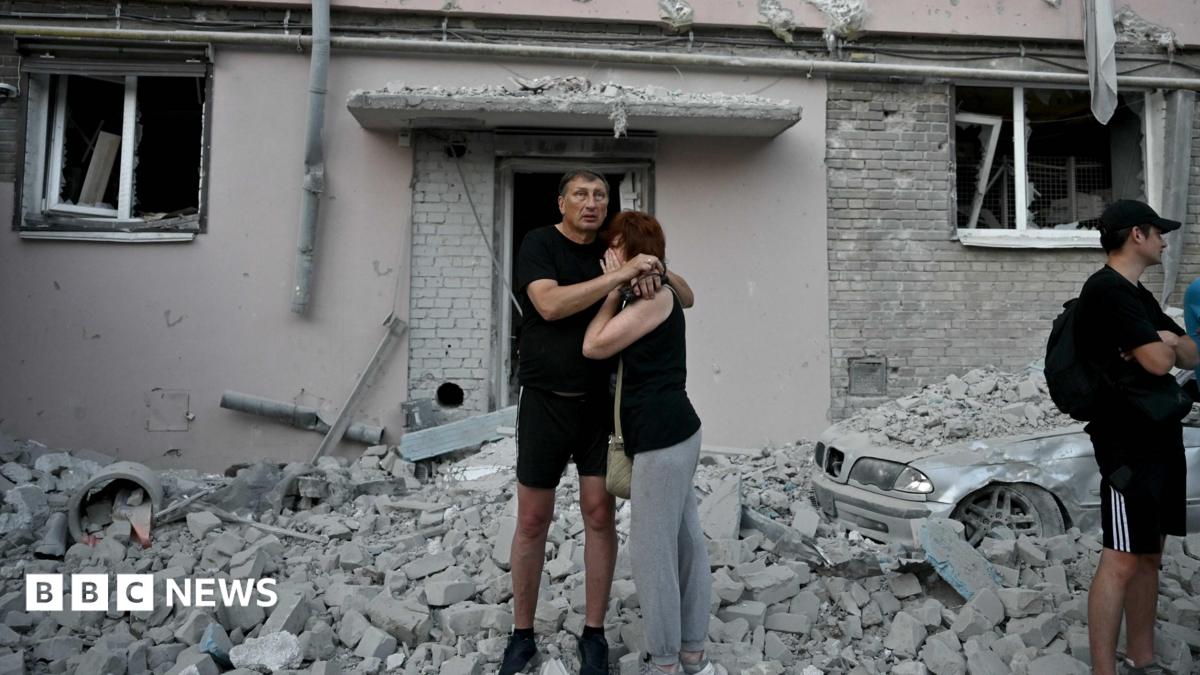
On the city’s left bank, in Darnitskyi district in south-east Kyiv, two missiles hit a residential area directly, causing devastation.
One missile left a giant crater next to a kindergarten and the buildings all around have been gutted by fire, their metal balconies twisted.
The second missile landed a few steps away and hit the end of a 9-storey block of flats. It has collapsed, sliding off the face of the building, into a heap of concrete. One local told the BBC that several people were missing and they may have been in the basement, sheltering.
There are smashed cars and smashed windows and a thick layer of grey ash coating everything and everyone.
Rescuers have been trying to dig through the rubble to reach them as relatives watch, in tears.
Svitlana, who lives next to the building that was hit, told the BBC she was hiding in the corridor during the air raid and heard the explosions.
“It wasn’t scary,” she shrugged, “Because I’ve been through it all before.” She then revealed that she had been badly injured in another Russian strike on another town which killed her mother. Two years later, her son was killed in action fighting for Ukraine.
Oleksiy, his face covered in cuts and blood, told the BBC he had stepped outside to smoke after he heard the first missile, then the second one landed and he was hit by flying glass.
“This is not retaliation by Russia for Ukrainian strikes,” he said, dismissing Moscow’s explanation for its latest attack. “They started this war. This is a residential area. And they targeted it.”
