

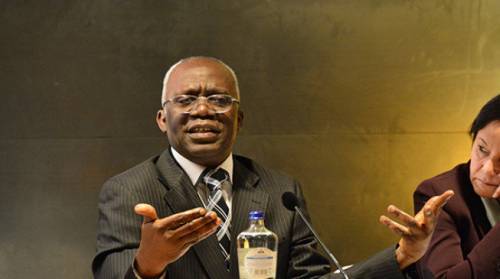
Human rights lawyer Femi Falana (SAN) has faulted claims that socio-economic rights are not justiciable or enforceable by Nigerian courts.
Falana made this known in a paper titled ‘Justiciability of Chapter Two of the 1999 Constitution (as amended): The Need for The Nigerian Judicial System to be More Proactive’ delivered at a meeting organised by the Nigerian Bar Association (NBA) on Tuesday in Lagos.

In his paper, the lawyer called for legal recognition and enforcement of the socio-economic rights of Nigerians which include the right to work, freedom of association, right to representation in public office, right to education, right to health, and right of equal access to public property.
According to him, the absence of such rights could lead to “human insecurity, widespread diseases and endemic infections lack of access to health care, all resulting in deprivation, as well as a retarded economic development and poor standard.”
He said: “There are several decisions of domestic and regional courts which have upheld the socio-economic rights of the people, lawyers and judges have continued to give the misleading impression that only civil and political aspects of fundamental rights are enforceable in Nigeria.
“The victims of violations of socio-economic rights have been left without access to the remedies provided by law. To compound the crisis, some judges in the High Courts have continued to invoke the anachronistic doctrine of locus standi to dismiss or strike out public interest cases filed by public interest litigators to secure the enforcement of socio-economic rights of disadvantaged citizens or groups.
“The International Covenant on Civil and Political Rights and International Covenant on Economic, Social and Cultural Rights have been ratified by Nigeria. Many countries have denied the existence of social and economic rights and refuse to give them any legal character.
“Some jurists argue that socio-economic rights do not constitute legal norms but only guiding principles. At the regional level, the member states of the African Union adopted the African Charter on Human and Peoples’ Rights in 1986. Apart from ratifying the African Charter the Federal Government domesticated it.
“The African Charter contains political and civil rights as well as socio-economic rights and solidarity rights. The socio-economic rights include the right to work, freedom of association, right to representation in public office, right to education, right to health, right of equal access to public property, right of women and children recognized in all international conventions and treaties.
“Socio-economic rights are enshrined in Chapter 2 of the 1999 Constitution of the Federal Republic of Nigeria. They are part of the fundamental objectives and directive principle of state policy. As far as members of the ruling class are concerned, they are the ideals towards which the nation is expected to strive to meet socio-economic rights for the citizenry.
“It is submitted that social and economic rights are interconnected to a broad range of political and civil rights. For example, the right to life is negated when there is an absence of the right to food. Furthermore, the right to dignity is defeated if there is no right to affordable housing. Most crucially, it ought to be pointed out that the individual needs socio-economic rights for the realization and enjoyment of the right to exist.
“In other words, the right to health is connected to political, economic and social welfare and safety for all citizens of Nigeria. Its enforceability is crucial for the sustenance of Nigeria. The lack of which may result in human insecurity, widespread diseases and endemic infections lack of access to health care, all resulting in deprivation, as well as a retarded economic development and poor standards of living.”
Citing ways socio-economic rights have been enforced in the past, Falana said “It is high time the debate on socio-economic rights was moved from desirability to enforcement. Socio-economic rights must all be read together in the setting of the Constitution as a whole. The State is obliged to take positive action to meet the needs of those living in extreme conditions of poverty, homelessness or intolerable housing.
“The Nigerian Bar Association and the human rights community should wage a serious campaign against disobedience of court orders. As far as I am concerned, the Attorney-General who disobeys a court order should be penalised by the Legal Practitioners Disciplinary Committee.”
