


A CONVERSATION WITH LaMelo Ball is like eavesdropping on an interior monologue. Back in January, when such things were still possible, Ball was sitting in a café in Wollongong, Australia, eating his daily chicken Caesar salad, no dressing, no cheese. He was talking about the possibility of being chosen first in the NBA draft and whether it means anything to him (kinda sorta but the fit is the thing) when he hummed a few bars of something I didn’t recognize and he interrupted himself, for reasons known only to him, by saying:
“God. Bless. America.”
Yep yep.
“I just leave everything up to God.”
He will be drafted in the first five picks on Oct. 16, possibly No. 1, and the highlight clips will show him playing in unfamiliar uniforms in faraway lands, making over-the-shoulder passes to players you’ve never heard of in places you’ve probably never been. He never played under the hot lights of Cameron Indoor or amid the pomp of the NCAA tournament.
Instead, he has lived the life of spectacle. He is an object of curiosity, a carny barker’s delight: Step Right Up And See The Amazing Basketball Prodigy. He signed his first autograph at 5 or 6, after word of his precocious ballhandling skills reached the students at the middle school where his mother, Tina, worked. He played with brothers Lonzo and LiAngelo as a freshman at Chino Hills High School, on a team that went 35-0, won a state championship and led the nation in fire code violations. He scored 92 points in a game in his sophomore year and received the kind of public scorn normally reserved for people older than 15.
He is almost defiantly resistant to self-reflection, partly because of the lifelong intrusions into his private life, mostly because he’s 18. But his actions speak. In Wollongong, we went to the same café three times, and each time Ball rushed ahead to hold the door open for the group. One time he pulled off the veteran move of surreptitiously paying for the meal under the guise of using the bathroom. When he arrived for his first practice with the Illawarra Hawks, he went around to every person in the locker room, introduced himself and asked how they were doing. The next day, same thing. “He did it every single time he entered a room or a practice court,” Flinn says. “I had no previous perception of some of the stuff other people were privy to — I had never seen the show — but I immediately saw this kid was raised the right way. His joyfulness grabbed me.”
Flinn has an anecdote at the ready, one he likes to tell: Early in the season, he stood before his team ready to impart wisdom. He had a story prepared, the parable of the two wolves, and it starts out with a description of the wolves in question. There is the Bad Wolf, who is responsible for spreading depression and creating dissension among his teammates. There is the Good Wolf, who is selfless and generous, eager to dive on the floor and pass up an open shot to get his teammate a better one. Each of you, Flinn told them, has a bad wolf and a good wolf battling inside of you.
“Do you know which wolf wins?” Flinn asked his team.
There is, of course, an allegory at work here, and Flinn was asking the question to set up his own answer. But before he could get there, LaMelo shouted, “The good wolf!” breaking up everyone in the room.
“I have no doubt you’re a good wolf, mate,” Flinn told him, “but Melo, the moral of the story is this: The wolf that wins is the wolf you feed.”
The positivity flows from every pore, as does the youthful exuberance. He’s just 18 but already can’t count the number of countries he’s visited. Places, like defenders, are obstacles to be navigated over, around and through, then stacked up and put away for later. The passport is impressive, but the experience is limited. LaMelo Ball has lived a life of international isolation, always using one place in service of getting someplace else.
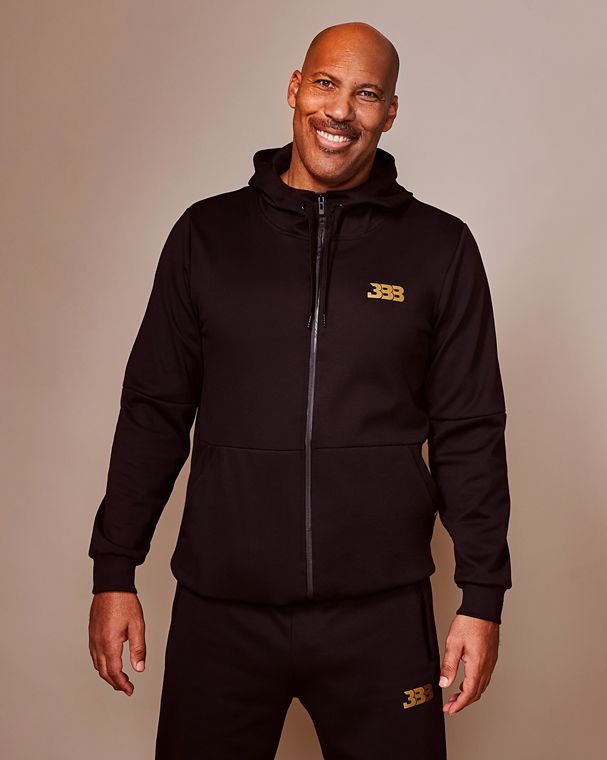
LaVar Ball is never more animated than when he is evangelizing for his three sons. He awaits the moment when all three are in the NBA, when he can say, “You know what? Big Baller’s job is done.” G L Askew II for ESPN
THERE’S A MONSTROUS Big Baller Brand logo centered on the front of the monstrous, 16,000-square-foot house, like a coat of arms on a castle. There’s a monstrous Big Baller Brand logo in a monstrous chandelier hanging in the monstrous living room. LaVar Ball’s tour of his Chino Hills house includes a lingering, description-rich stop in his “$100,000 Room” — a dining room that he says is used once a year, on Thanksgiving, and that derives its name from the combined cost of the furnishings. As he lovingly explains the genus and species of each of the 12 upholstered chairs, it’s terrifying to imagine the fate of some gravy-spilling aunt or uncle.
LaVar is big, loud, profane, welcoming, challenging, hilarious. It’s like sharing space with a waterfall. He throws himself across a lavish green sofa with his arms flung to either side, the wingspan impressive. It’s June, and all three of his boys are home, spraying inside jokes around an adjacent room, and LaVar luxuriates in a permanent state of gloat. He takes me out to his front yard (monstrous, with fountain) and explains how he removed all the trees, shrubs and lawn — everything growing, in other words — and installed artificial turf and white landscape rock. “What do I need with all those trees?” he asks, and his laugh fills the sky.
He refers to himself as Big Baller, as in, “The lady at the gas station looked up and realized, ‘That’s Big Baller right there,'” and he says things like, “Nobody ever heard of Lithuania until my boys went there.” He is never more animated than when he is evangelizing for his three sons. He awaits the moment when all three are in the NBA, when he can say, “You know what? Big Baller’s job is done.” He is a zealot awaiting the Rapture.
LaVar was his sons’ first coach, and he trained them nearly from birth. The after-school scene outside their (former, pre-monstrous) home in Chino Hills resembled a basketball camp: the three Ball brothers, neighborhood kids, the kids of LaVar’s friends from around Los Angeles. They ran hills and were put through shooting drills and played 3-on-3 ’til it got dark.
“He was tough on all three of us,” LaMelo says, before pausing to rethink his answer. “I wouldn’t even say tough, though. But if you were just a random person seeing him coach us, you’d be like, ‘What the hell?'”
LaMelo’s talent, coming after Lonzo’s and LiAngelo’s, allowed LaVar to dream monstrous dreams of endless possibility. Just before LaMelo’s sophomore year in high school, as Lonzo was preparing to play at UCLA, LaVar started the Big Baller Brand. He made a signature shoe for LaMelo, who was 16 at the time. Fanfare — and the hiring of an agent — followed, and the combination of those cost LaMelo his college eligibility and set in motion an unprecedented global journey that had one theme: NBA or bust.
First stop: Lithuania, where LaMelo, his flop of reddish-brown hair bouncing with every dribble, looked sad and out of place. He was a mere child, skinny and unsure, playing against hardened men who resented his very presence. He did, however, become the youngest American professional basketball player ever — step right up — after he and LiAngelo signed their deals in December 2017 and provided the platform for LaVar to preach the gospel of his sons to anyone who would listen.
“I was like, ‘You know what? To make him even better, let’s just go focus on basketball,'” LaVar says. “Melo didn’t have to do all these term papers and chemistry tests and all that. But now Melo would have to grow up fast because you don’t have the guys at lunchtime to joke and laugh with. You’re just dealing with grown men all the time.”
LaMelo played in just eight games, averaging roughly six points and two assists. With a few television episodes in the can and a dispute with the coaching staff brewing, LaVar declared victory and brought his sons back to California. As he’s asked to look back on the trip, the obvious question about normalcy and childhood and experiences lost is interrupted before it can be completed.
“We knew what we were there for. It got me in this position, so I can’t say nothing wrong, I guess.”
– LaMelo Ball
“No — no,” he says. “You see, I knew what you were going to ask before you asked it.” He pauses, smiles, pleased with himself. “He didn’t miss out on anything. Everybody’s talking about, ‘Oh, you missed out on the prom.’ Well, you didn’t miss out on buying no Lamborghini for yourself. You didn’t miss out on doing whatever you want and not asking your mom and dad for money. So what did he really miss out on? A couple of jokes here and there? You can live with that.”
LaMelo, for his part, says, “I wouldn’t have gone to prom anyway,” as if the choice was both commonplace and binary: the wild global spectacle of Lithuania or prom. Looking back, he remembers mostly the weather. “Whenever you say ‘Lithuania,’ I just be thinking about the hotel that was in the middle of nowhere,” he says. “And the snow. Cold gyms. Always just cold. We knew what we were there for. My dad told me, ‘This is one of the sacrifices you got to make.’ Leaving your friends. Leaving everything, you know? It got me in this position, so I can’t say nothing wrong, I guess.”
Perspective is important: The journey is nearly completed, the destination in sight, and so he speaks of his truncated childhood the way a war veteran speaks of battle as he’s marching in a victory parade. Lonzo, though, a grizzled sage at 22, shakes his head and says, “He was over there in Lithuania when he was 16. Just crazy. He’s seen a lot of different things just to play basketball.”
LaVar leans forward on the plush green couch. “My famous line is: Are you built for this?” he says, perhaps taking some liberties with the definition of fame. “Some people aren’t.”
When did he perceive that LaMelo was built for this?
“At what age? Before he came out of the womb,” he says. “All my boys. That’s why I had three of them. I had three monsters, and I knew I was going to have three monsters.”
I’m not entirely sure why, but I ask LaVar how he would have responded if one of his sons had told him, at age 12 or 13, that he wanted to quit playing basketball and turn his efforts toward becoming a veterinarian.
“They could have been a vet,” LaVar says, unconvincingly. “But don’t expect me to be hanging out with you because I ain’t going to be reading no books and all that. I hang out outside. I do pullups, dips, running hills. Now, if you want to deal with your dad, come on outside and have some fun with me.”
When I ask LaMelo to guess his father’s response to the question, he laughs and says, “I ain’t going to lie: I think he would have looked you dead in your eyes and just laughed. Get the f— out of here, Son, what are you talking about?“
Click Here to Visit Orignal Source of Article https://www.espn.com/espn/feature/story/_/id/29687839/the-mystery-lamelo-ball
